Key Takeaways:
- Weak front-end code structure leads to untraceable bugs and slow progress.
- Angular keeps your UI stable using proven reactive patterns.
- NgModules and RxJS make large codebases easy to scale.
- Clean architecture means faster updates and fewer errors.
- Pure Website Design delivers expert Angular solutions built for business growth.
Your app used to be manageable. Now, making a simple UI change means navigating nested components, bloated services, and unpredictable state flows. That’s what happens when platforms like SaaS tools, ERP systems, or banking dashboards outgrow their architecture.
These issues occur from architecture that doesn’t scale. That’s where Angular stands out. With scoped NgModules, lazy-loaded routes, RxJS-powered services, and full support for state management via NgRx, Angular provides a structure built to handle complexity.
In this guide, we’ll break down how Angular handles front-end architecture in complex projects and how to use those same principles to future-proof your own applications.
How Angular Manages Front-End Architecture
Angular’s architecture is intentionally structured for large-scale, maintainable apps. It does this by leaning on clear design patterns, modular development, and a powerful set of tools built into the framework.
Component-Based Structure
At the core of Angular is a component-based architecture. Every UI element is wrapped in a component that manages its own template, logic, and styling.
This makes the app scalable and allows developers to isolate and reuse features cleanly.
- Template handles the UI layout.
- Class contains the logic and handles user interactions.
- Metadata via decorators like @Component tells Angular how to use each component.
Modular Code with NgModules
Angular uses NgModules to split your codebase into organized feature sets. Each module can encapsulate a specific domain of your app like user profiles, product management, or analytics.
This makes large apps easier to manage, lazy-load, and test.
Dependency Injection (DI)
Angular’s built-in DI system allows you to inject services and other dependencies into components automatically.
This reduces tight coupling between parts of the app and makes unit testing more straightforward.
Services for Business Logic
Instead of cluttering your components with data fetching or processing logic, Angular promotes services like reusable, injectable classes that handle backend communication, business rules, or shared utilities.
Routing for Navigation
Angular’s Router enables seamless single-page navigation. Developers can define routes to link modules and components together, enabling users to move between views without full-page reloads.
Reactive State Management
For apps dealing with complex state (like forms, user sessions, or product filters), Angular can integrate with NgRx or RxJS-based services.
This provides a centralized, reactive way to manage application state that scales cleanly and keeps behavior predictable.
Micro Frontend Friendly
For enterprise-level apps, Angular can also support a micro frontend approach. Where individual features are developed in isolation and composed together.
This allows multiple teams to work independently while delivering a unified experience.
Expert Recommendation: Scaling shouldn’t feel like a burden. Let Pure Website Design handle the complexity for you.
As trusted Angular development experts, we build and scale complex applications that support your growth and free your team from technical roadblocks. Focus on your business! We’ll take care of the architecture.
Why Front-End Architecture Even Matters

Front-end architecture is often misunderstood. People think it’s about how things look. In reality, it’s about how things work together. The structure that keeps monitoring everything.
In complex apps, you have to manage dozens of data sources, async events, shared states, UI components, and user interactions. Without a clear architectural model, it turns into a very difficult and time consuming task.
To manage this multiplex, Angular It offers something very few front-end tools do: opinionated architecture. That’s not a limitation. It’s a relief.
What Makes Angular’s Architecture So Effective?
Angular handles complexity not by adding magic, but by giving structure. Its architectural backbone is made of four foundational pillars:
- Modules
- Components
- Services
- Dependency Injection
Each of these solves a different challenge. And together, they make scaling up less of a guessing game.
Let’s unpack how they work.
What Is the Role of Modules in Angular?
Modules in Angular act like smart containers. They group related features together for encapsulation and reusability.
You might have a UserModule that holds everything from profile components to login forms to services that handle authentication. That module becomes plug-and-play. You can lazy-load it, isolate its logic, and maintain it independently from the rest of the app.
This is especially critical in enterprise projects. Splitting a massive app into isolated, testable feature modules helps teams avoid collisions and keeps codebases manageable.
How Do Components Organize the UI?
In Angular, components are the face of your app. Every button, list, dialog, or widget is a component.
A component has three main parts:
- HTML Template – what the user sees
- CSS Styles – how it looks
- TypeScript Class – how it behaves
By separating logic and presentation this way, Angular forces you into a pattern that’s clean and predictable.
And thanks to Angular’s powerful data-binding (one-way, two-way, event binding), you’re not manually wiring UI events with DOM selectors. You stay inside the framework. That’s cleaner. Safer. More scalable.
What Makes Angular Services So Powerful?
Not everything should live in a component. That’s where services come in.
This is part of what makes Angular ideal for large-scale development: centralized logic and reusable services.
Imagine having ten different components that all need access to a user’s role or permission level. Instead of duplicating logic, you write one UserService and inject it wherever you need. That’s clean. That’s testable. That’s scalable.
How Does Dependency Injection Keep Things Scalable?
Angular’s dependency injection system is one of its core strengths. It lets you plug in services or data wherever you need them, without tight coupling.
This isn’t just a convenience. It’s what makes your app testable, modular, and future-proof.
Let’s say you want to switch your AuthService to use a new API. With dependency injection, you don’t touch every component. You change the provider in one place. Done.
This pattern, which Angular enforces by default, avoids the brittle, tangled mess that many JavaScript apps fall into over time.
How Angular Handles State Management
Angular doesn’t force you into one global state library like Redux. Instead, it gives you flexibility.
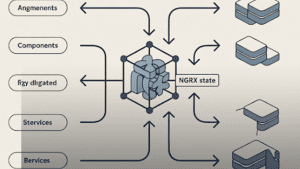
For simple projects, services with observables are often enough. You can use BehaviorSubject or ReplaySubject to hold reactive data that updates across components.
What Is Angular Routing and Why Is It Scalable?
Routing is where many front-end frameworks get messy. But Angular’s RouterModule is mature, reliable, and capable of handling deeply nested routes, guards, lazy loading, and route parameters.
You don’t need third-party libraries to manage the flow between views. Angular’s router does it all. With clear separation between paths, components, and modules.
You can even build route-based loading strategies so the user only downloads what they need. That saves bandwidth and speeds up performance.
How Does Angular Handle Performance in Large Projects?
Angular apps are fast, but performance doesn’t come from magic. It comes from smart defaults and optional optimizations.
Here’s what helps:
- Ahead-of-Time Compilation (AOT) – compiles templates during build, not runtime
- Change Detection Strategy – OnPush mode tells Angular to skip checks unless needed
- Lazy Loading – loads feature modules only when users visit certain routes
- Tree Shaking – unused code gets stripped out automatically
When configured right, Angular can compete head-to-head with any modern framework. And with Angular CLI handling most of the grunt work, you don’t have to micromanage your build.
How Does Angular Scale Across Teams?
Code quality isn’t just about writing good functions. It’s about consistency across developers.
Angular enforces structure. You’re not reinventing how files are named or where logic lives. That predictability makes onboarding easier, code reviews cleaner, and collaboration smoother.
In fact, this is why many leading Angular development companies stick with Angular for client work. It reduces decision fatigue and brings predictable output at scale.
Need extra hands? A solid Angular development partner will already know the architecture inside out. No long ramp-up time. No architecture debates.
But not every agency claiming to be “Angular experts” knows what they’re doing. You’ll want to spot the red flags of an Angular development agency before making a call.
What Are the Limitations of Angular’s Architecture?
No framework is perfect. Angular is opinionated and for some, that’s frustrating.
The learning curve is real. You’re not just picking up syntax, you’re learning a way of building. But once it clicks, it pays off.
Also, Angular apps tend to have larger bundle sizes compared to lighter frameworks like Vue or Svelte. That’s the trade-off for including more features out of the box. But with smart lazy loading and optimization, this isn’t a deal-breaker.
Why Angular Still Dominates Complex Front-End Development
Angular may not be trendy. It may not win popularity polls. But it doesn’t have to.
It’s stable. It’s scalable. It’s structured.
That’s why teams at Google, Microsoft, Deutsche Bank, Upwork, and others continue to use it in mission-critical apps. They don’t want a sleeky framework. They want something that lasts.
If you’re working on a substantial project, Angular gives you everything: routing, forms, testing tools, animation APIs, i18n, PWA support, strict typing and a complete CLI that makes building consistent apps feel seamless.
Why Pure Website Design Is a Smart Choice for Angular Projects
The Angular framework is a reliable option for handling complex web applications. But if your Angular developers lack real expertise, the result is not just a failed project but also wasted time and money.
Instead of spending hours reviewing proposals without knowing what to look for in an Angular company, it is smarter to choose a trusted Angular development partner like Pure Website Design.
Our team of expert Angular developers builds scalable and maintainable front-end structures. The code stays clean, organized, and easy to grow with your business.
Frequently Asked Questions
Why is component-based architecture useful
It breaks the UI into smaller parts so developers can build, test, and reuse elements without rewriting everything. That’s how Angular keeps things clean and manageable.
How does Angular handle performance
Angular uses lazy loading, change detection strategies, and efficient data handling with RxJS. These help apps load faster and run smoother even as they grow.
What’s the role of services in Angular
Services carry logic like data fetching or validation outside of the components. That makes components simpler and apps more organized.
Who should use Angular for frontend
Any team working on a dynamic, large-scale app can benefit. Startups, enterprises, and government platforms all rely on Angular for consistent performance.
How does Angular help with team collaboration
With a defined folder structure, shared services, and clear separation of concerns, teams can split tasks and work in parallel. Pure Website Design uses this approach to speed up development.
What’s the benefit of reactive programming in Angular
Using RxJS, Angular lets developers react to data changes in real-time. This makes building responsive features like live search or notifications much easier.
Where can you find Angular experts
Many agencies offer Angular services, but look for those who specialize in large-scale apps. Pure Website Design has a proven record in architecting scalable Angular solutions.
When should routing be used in Angular
Routing comes into play when navigating across views or modules within a single-page app. Angular handles this through its built-in Router for seamless transitions.
Final Word
Angular isn’t for everyone. But if you’re building something big, complex, or meant to last, Angular’s architecture will carry your project farther than most other options.
You get structure without sacrificing flexibility. Opinion without lock-in. And a global community that’s actively solving the same problems at scale.
And if your team needs help structuring Angular the right way, the advantages of Angular development partner support can’t be overstated. The right team doesn’t just write clean code. They build clean systems.